

To chase an unpaid invoice, send a friendly reminder the day after it's due, then follow up at about 14 and 30 days, a little firmer each time. Name the invoice number, the amount, the payment terms and the due date in every message, so the client can pay without searching. A late invoice is often a forgotten one, so start friendly.
Here's how to do it step by step: what to gather, when to send, four emails with the invoice number, payment terms and due date in place, and what to do if the client still doesn't pay.
What do you need before you chase an unpaid invoice?
Gather the facts first, so the client's accounts team can match your reminder in one look.
- Invoice number, and the date you sent it.
- Amount and currency, as on the invoice.
- Payment terms as agreed, such as net 30, net 45 or due on receipt, and where they're written: the contract, the quote or an email.
- Due date as an actual date, like October 31, not "30 days".
- What you delivered and when: the deliverable, the date and any sign-off. "Homepage and three inner pages, approved October 2" does more work than "the website".
- Who should receive it: the accounts payable contact, plus any purchase order (PO) or reference number they need. Many accounts teams won't pay without a PO number, so a sales lead may need one from the client before reissuing. If your contact has left, as often happens to an agency on a long retainer, ask the client who approves invoices now before you chase anyone.
Before you call it late, check the invoice arrived and is correct: a wrong address or missing PO number often stalls it. If you're still making invoices by hand, our free invoice template for Google Docs and Sheets has a field for every item on this list and prints the due date as a date.
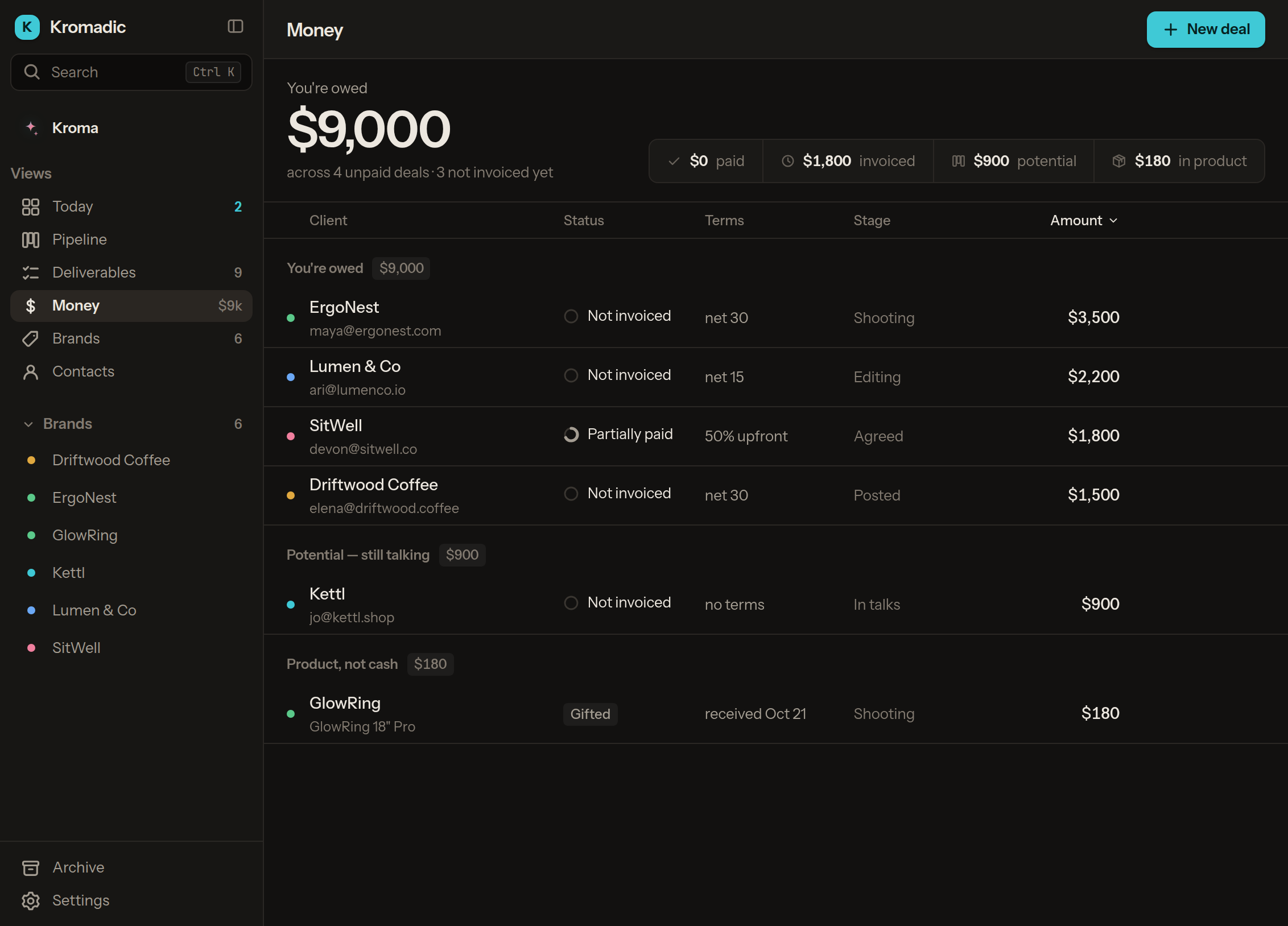
If your deals live in Kromadic, the invoice number, terms and due date are already on the deal. The Money view shows who owes you and how much, and Kroma flags an invoice the day it passes its due date, with how many days over. You still send the email yourself.
When should you chase an unpaid invoice?
Follow a simple schedule counted from the due date, and get a little firmer at each step.
| When | What to send | Tone |
|---|---|---|
| 3 days before the due date (optional) | Email 1: a friendly heads-up | Friendly, helpful |
| 1 day late | Email 2: the first reminder | Friendly, assumes it slipped |
| 7 days late | A short call or DM to check it reached the right person | Practical |
| 14 days late | Email 3: ask for a payment date | Direct |
| 30 days late | Email 4: the final reminder | Firm, still polite |
| 45+ days late | Decide on next steps (see "What if they still don't pay?") | Formal |
Adjust the days to your terms, and stop the moment the client replies with a date or a question: chasing someone who has already answered damages the relationship. A designer whose $2,400 website invoice on net 30 is 9 days late has sent email 2 and should call now, with email 3 ready for next week.
How do you politely chase an unpaid invoice? Four emails to copy
Polite means specific, not vague. "Just checking in" gets ignored; an email that names the invoice, amount, terms and date gets forwarded to whoever pays. Fill in the [brackets] and send.
1. A friendly heads-up
Before it's due: about 3 days ahead. Optional, and worth it for new clients and big invoices.
Hi [Client name],

A quick heads-up that invoice [Invoice number] for [Amount] is due on [Due date], on [Payment terms, e.g. net 30] from [Invoice date]. It covers [What you delivered], delivered on [Delivery date].

I've attached the invoice again so it's easy to find. You can pay by [How to pay].

If your accounts team needs anything to process it, such as a PO number, a W-9 or tax form, or a different contact, let me know and I'll send it today.

Thanks,
[Your name]
2. The first reminder
1 day late: the day after the due date.
Hi [Client name],

Invoice [Invoice number] for [Amount] was due on [Due date], on [Payment terms, e.g. net 30]. It covers [What you delivered], delivered on [Delivery date].

I've attached the invoice again. You can pay by [How to pay].

If it's already on its way, thank you, and please ignore this. If something is holding it up, let me know and I'll help sort it out.

Thanks,
[Your name]
3. Ask for a payment date
About 14 days late.
Hi [Client name],

I'm following up on invoice [Invoice number] for [Amount], for [What you delivered]. It was due on [Due date] on [Payment terms, e.g. net 30], so it's now 14 days overdue.

Could you confirm a date this week when it will be paid? I've attached the invoice again, and you can pay by [How to pay].

If it should go to someone else in accounts payable, or anything on it needs correcting, tell me and I'll resend it today. If paying in full is hard right now, I'm open to part now and the balance by [New deadline].

Thanks,
[Your name]
4. The final reminder
About 30 days late, after at least two earlier reminders.
Hi [Client name],

I'm following up once more on invoice [Invoice number] for [Amount], which was due on [Due date] on [Payment terms, e.g. net 30]. It's now [X] days overdue.

I know invoices can get held up. If something is in the way, tell me and I'll help sort it out, whether that's sending it to someone else, correcting a detail or splitting it into a payment plan.

Otherwise, could you arrange payment by [New deadline]? I've attached the invoice again, and you can pay by [How to pay].

If it's still outstanding after that, I'll need to [pause further work until it's settled / add the late fee in our agreed terms].

Thank you for sorting this out,
[Your name]
Only name a consequence you're willing to follow through on.
Should you call or send a DM instead?
Often, yes. A call sorts out what emails can't, like the wrong contact, a missing PO number or someone on leave. For deals that started in DMs, the same thread is often fastest.
- Have the invoice open, and name it: the invoice number, the amount and the due date.
- Ask whether it reached the right person, and whether anything is missing.
- Ask for a specific payment date, not "soon".
After the call, send a short email confirming what was agreed, so there's a written record. A creator whose invoice for a sponsored reel is on net 45 and has gone quiet in DMs can send this first, then follow up by email:
Hi [Name], quick one: invoice [Invoice number] for [Amount] ([Payment terms]) was due [Due date]. Who's the best person in accounts to send it to?What if they still don't pay?
Escalate one step at a time, in writing.
- Pause new work until the invoice is settled, and say so in writing.
- Offer a payment plan: part of the amount now and the rest by set dates, confirmed by email.
- Go above or around your contact. Write to accounts payable or the finance lead. A talent manager chasing a brand's agency on a creator's behalf can copy the brand contact, with the agreed fee and terms in front of them. Keep it factual.
- Send a formal demand letter that restates the debt, the evidence and a final deadline.
- Use small claims court for smaller amounts, where it's available. Limits and process vary by state and country; Nolo's overview of small claims for business disputes is a plain-English starting point in the US.
- Hand it to a collection agency as a last resort. They usually keep a share of what they recover.
- Know your local protections. In the UK, businesses can claim statutory interest on late commercial payments, and in New York City the Freelance Isn't Free Act requires a written contract for freelance work worth $800 or more and payment on or before the date in it.
This is general information, not legal or tax advice. Rules on late fees, interest and debt recovery vary by country and state, so check local rules or ask an accountant or lawyer before you add charges or take formal steps.
What does net 30 mean on an invoice?
Net 30 means the full invoice amount is due within 30 calendar days, usually counted from the invoice date unless the terms say otherwise.
For example, an invoice dated October 1 on net 30 is due October 31, and it becomes late on November 1.
| Term | When it's due |
|---|---|
| Due on receipt | As soon as the client receives the invoice |
| Net 15 | 15 days after the invoice date |
| Net 30 | 30 days after the invoice date |
| Net 30 EOM | 30 days after the end of the month the invoice is dated |
Print the actual due date on the invoice, so nobody has to count.
How do you avoid late payments next time?
Most late payments are set up before the work starts.
- Agree terms in writing before work starts: the amount, the payment terms and when the clock starts.
- Ask for a deposit or milestone payments on new clients and big projects.
- Invoice the day the work is done. Every day you wait pushes the due date out.
- Put the due date on the invoice as a date, with the invoice number, the terms and how to pay.
- Send it to the right person: accounts payable, with any PO or reference number they asked for.
- Charge late fees only if they were agreed upfront and are allowed where you are (see the note above).
- Keep a running list of who owes you and how late, so the 1-day reminder actually goes out on day 1.
Kromadic makes the invoice PDF from the deal, with your business details and a stored invoice number, so the terms you agreed are the terms on the invoice. It's free for up to 10 active deals. Here's why we built Kromadic.
Questions people ask
How long should you wait before chasing an unpaid invoice?
Send the first reminder the day after the due date. Waiting longer only pushes the payment further out, and most clients have simply missed it. If the invoice is large or the client is new, a short heads-up about three days before it's due can stop it slipping in the first place.
How many reminders should you send before escalating?
Usually three emails and one call over about 30 days: a friendly reminder the day after it's due, a call or DM at a week, a firmer email at 14 days and a final reminder with a deadline at 30. If there's still no payment or reply, decide on next steps such as pausing work.
Is it rude to chase an unpaid invoice?
No. The client agreed to the terms and you delivered the work, so asking to be paid on time is ordinary business. A reminder reads as rude only when the tone turns accusatory. Name the facts, assume it slipped, and offer to help with anything their accounts team needs to pay it.
Can I charge a late fee on an overdue invoice?
Only if the fee was part of your agreed terms and is allowed where you are. Adding a charge the client never agreed to usually starts a dispute rather than ending one. Rules differ by country and state, so check local rules or ask an accountant before you add any fee or interest.
How long can you chase an unpaid invoice?
Legally, the time limit for recovering a debt depends on your country or state, and it's often several years. Practically, chase early: the older an invoice gets, the harder it is to collect, because contacts move on and memories fade. Check your local rules if an invoice is already very old.
What should you do if a client disputes an invoice?
Stop the reminders and ask exactly what is disputed. Fix or explain that part in writing, and reissue the invoice if anything on it changes. Then ask the client to pay the undisputed amount now, so a disagreement over one line doesn't hold up payment for the rest of the work.


