

If you run deals, you know where they live. The first conversation is in an email thread or a DM. The price you agreed is in your notes app. The deadline is in a spreadsheet someone meant to update. The contract is a PDF in your downloads folder. And whether you've actually been paid lives mostly in your head.
That works for one deal. At five, things start to slip. A deadline gets remembered a day late. An invoice never goes out. A term you agreed with one client quietly gets in the way of the next, and you find out when it's too late to do anything about it.
None of that is a discipline problem. It's a filing problem: the facts about one deal are spread across tools that don't know about each other. So we built one place for all of them.
What Kromadic is
Kromadic is a deal workspace for small sales teams, freelancers, agencies and creators. Every deal sits in one pipeline, from the first pitch to the day it's paid. The agreed terms stay attached to the work. It shows you when one deal is blocking another, keeps track of who owes you money, and makes your invoices.
Built in is Kroma, an assistant that knows your whole workspace. Ask it a question and it answers from your real deals. Ask it to do something and it shows you exactly what it would change, with one button to approve it.
Our line for it is Run the deal. Close the loop.
What it does
One pipeline, pitch to paid
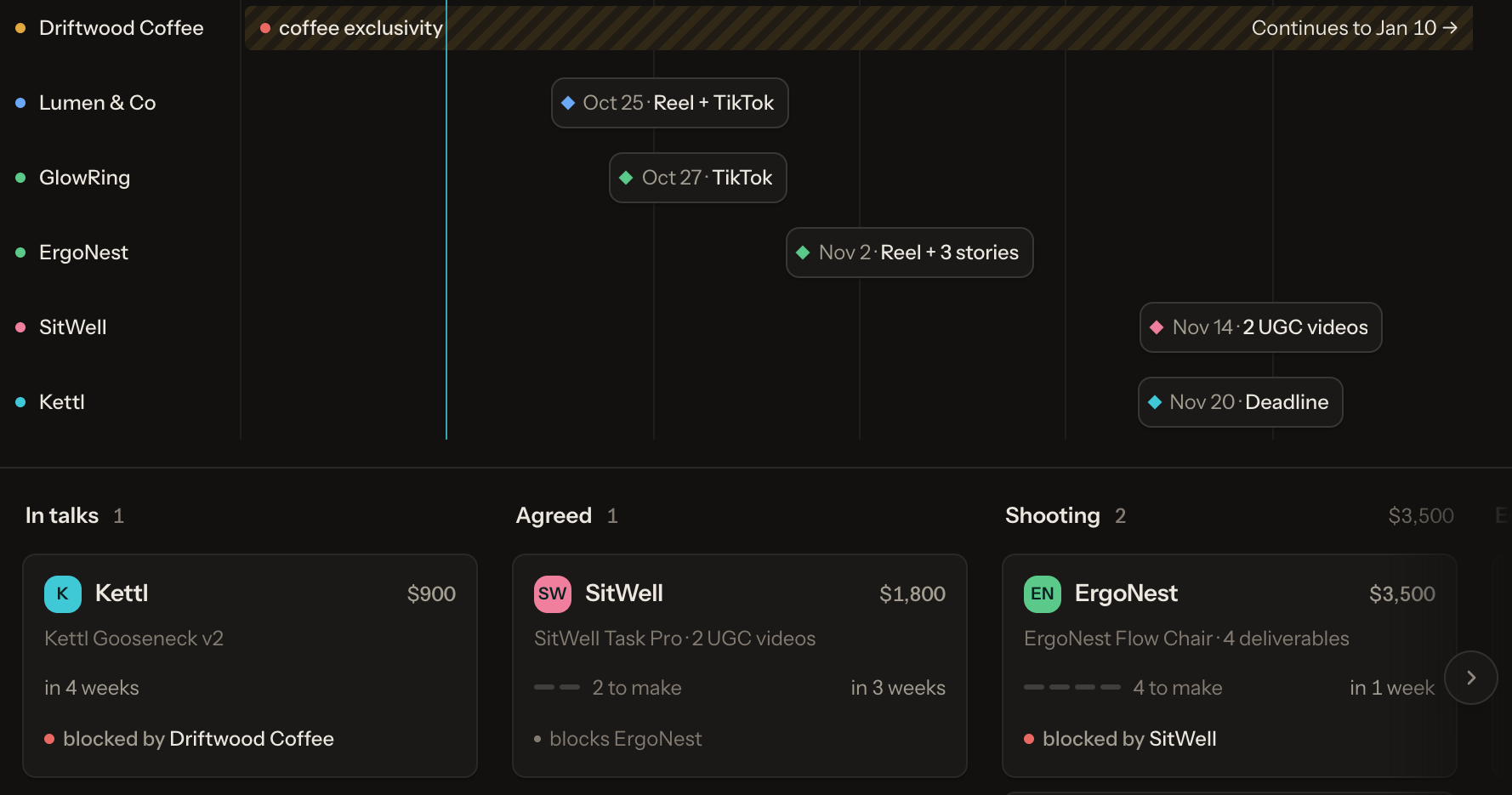
Every deal is a card on a board, sorted by stage, with the fee, progress and next date on its face. The stages are yours to rename and reorder. Above the board, a timeline shows how much is due each week and which exclusivity windows are running.
Terms live with the work
Deliverables, deadlines, payment terms, usage rights and exclusivity stay on the deal they belong to. "When is this due?" and "how long can they use it?" stop being trips back to the contract.
It notices when one deal blocks another
This is the part a spreadsheet can't do. Say you've agreed to 90 days of coffee exclusivity with Driftwood Coffee, and a kettle brand is now in talks. Kromadic sees the overlap and puts a blocked by Driftwood Coffee chip on the kettle deal, with the day it clears. It does the same when the order of the work matters, like a deal that can't go live until another one has posted.
It tracks who owes you
Money shows what's outstanding and what's been invoiced but not paid, and Kroma can tell you which clients tend to pay late. Chasing an invoice starts with a name, not a search. (For the emails themselves, here's how to chase unpaid invoices, with four to copy.)
It makes the invoice
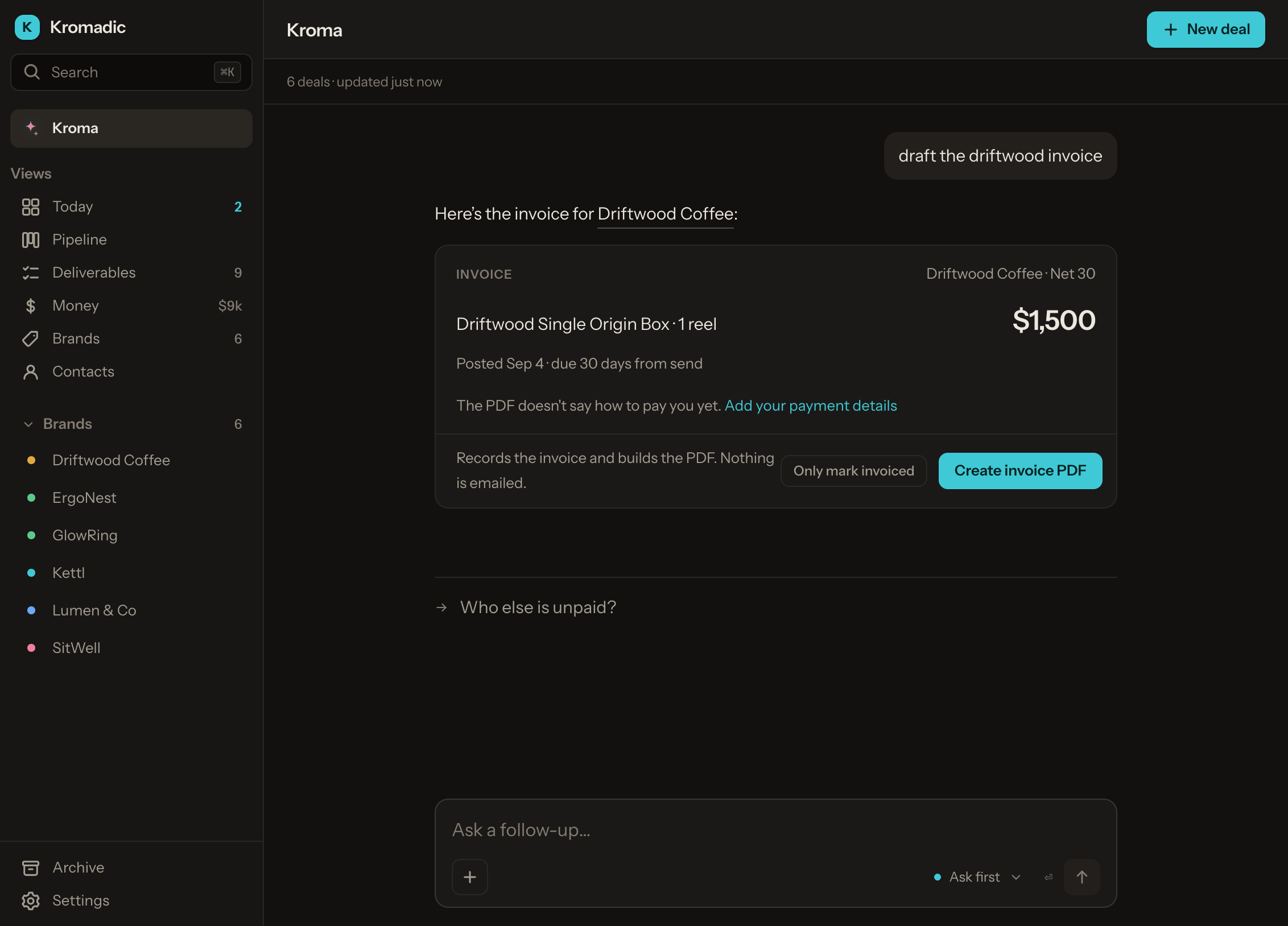
Real PDF invoices, with your business details, how to pay you, and an invoice number that never changes, even if you withdraw an earlier one. Kromadic doesn't take a cut of anything you invoice.
It keeps the relationship
Company and contact pages show everyone on the other side of your deals, with your notes, their deals and a timeline of what happened and when. Follow-ups with a date land on your Today view the week they're due.
Kroma has already read everything
Kroma is the first thing you see when you open Kromadic. Ask "what's due this week?" or "who still owes me?" and the answer comes from your actual deals, with every name a link to the deal behind it. Tap Brief me and it tells you where you stand, what changed since you last looked, and what's coming in the next two weeks.
Drop a contract into the chat and Kroma reads it into a new deal: the fee, the deliverables, the dates, the usage and exclusivity terms. It flags anything worth a second look, such as perpetual usage or exclusivity with no end date, asks for whatever it couldn't find, and saves nothing until you say so.
When Kroma wants to change something, like recording an invoice or making the PDF, it shows you the change on a card with one button. You decide. On Pro you can turn on Auto mode, where Kroma makes the change itself, says what it did, and offers Undo.
Who it's for
- Small sales teams and freelancers. Your clients, contacts, history and terms next to every deal, instead of spread across a CRM, a spreadsheet and your inbox.
- Agencies and talent managers. See what's late, unpaid or blocked across everyone you represent, before anyone has to ask.
- Creators. Every brand deal, deadline, exclusivity window and payment in one place.
When you sign up, Kromadic asks what kind of work you do and adjusts its words and starting pipeline to match. A sales team sees Clients where a creator sees Brands, and you can rename them yourself.
Why not a spreadsheet, a CRM or a chatbot?
A spreadsheet holds whatever you type into it and nothing more. It doesn't know that one row blocks another, it doesn't rank who's late paying you, and it doesn't make the invoice.
A CRM is usually built around finding and closing leads. Kromadic is built around what happens after the yes: the terms, the work, the deadlines and the money. It keeps a light record of companies and contacts, because every deal is with someone, but the deal is the point.
A general chatbot starts from a blank page every time. You paste in the contract, the price and the dates, and it only knows what you remembered to tell it. Kroma already holds every deal, person, invoice and term, and it will still have them six months from now.
What it costs
- Free, $0. Up to 10 active deals at a time, 40 questions to Kroma a month and 3 contracts read into deals. No card needed.
- Solo, $14 a month or $140 a year. No cap on active deals, 300 questions to Kroma a month and 30 contracts.
- Pro, $49 a month or $490 a year. 1,000 questions to Kroma a month, contracts without a cap, and Auto mode.
Your deals, invoices, notes and history are never locked behind a plan. They're yours to read and edit on every plan, including after a downgrade. The pricing page has the full comparison.
Try it
Start free with just your email. There's no card and no password: we send you a sign-in link. Add your first deal from a contract, a sentence or a blank page.
Then tell us what you think: what's missing, what's confusing, what you'd want next. Write to hello@kromadic.com. A person reads every email.
Questions people ask
Is Kromadic only for creators?
No. It's for anyone who runs deals: small sales teams, freelancers, agencies, talent managers and creators. The words and the starting pipeline adjust to your work.
Is Kromadic a CRM?
It includes a light one: companies, contacts, history and follow-ups. Its focus is the deal itself.
Can Kromadic read my contracts?
Yes. Drop a PDF into Kroma and it reads the contract into a deal: it says what it found, flags anything worth a look and asks for what's missing. Nothing is saved until you confirm. Once you do, the contract's text stays with the deal, so you can ask Kroma about it later.
Is my deal data private?
Your workspace is private to your account. When you ask Kroma a question, your deal details and the question go to our AI provider to produce the answer, along with a contract's text when the question is about that deal. None of it is used to train models, and your data is never sold. The privacy policy has the details.


